Finding Texas government bids means learning three acronyms, and once you do, the whole system makes sense. Texas separates getting listed (the CMBL), finding open solicitations (the ESBD), and ordering from term contracts (TxSmartBuy), and each does a distinct job. Add the state’s HUB program for small and disadvantaged businesses, plus the enormous local market of Texas cities, counties, and school districts, and you have one of the biggest procurement landscapes in the country. This guide walks each piece in plain terms, with a focus on the Electronic State Business Daily where the open bids actually live, so you know exactly where to look and what to do.
The Texas procurement landscape
Texas procurement is run by the Comptroller’s Statewide Procurement Division, and it splits into three systems plus a certification program. Sorting them out is most of the battle.
The CMBL (Centralized Master Bidders List) is the registered-vendor list; agencies use it to invite vendors to bid by commodity code. The ESBD (Electronic State Business Daily) is where agencies post solicitations above the bid threshold for anyone to find. TxSmartBuy is the ordering catalog for established term contracts. And the HUB program certifies historically underutilized businesses.

Where Texas government work lives
| System | Job | Cost |
|---|---|---|
| CMBL | Get solicited by agencies, by code | Annual fee |
| ESBD | Find open state solicitations | Free to search |
| TxSmartBuy | Sell via term contracts / catalog | Contract-based |
| Local portals | County, city, school district bids | Mostly free |
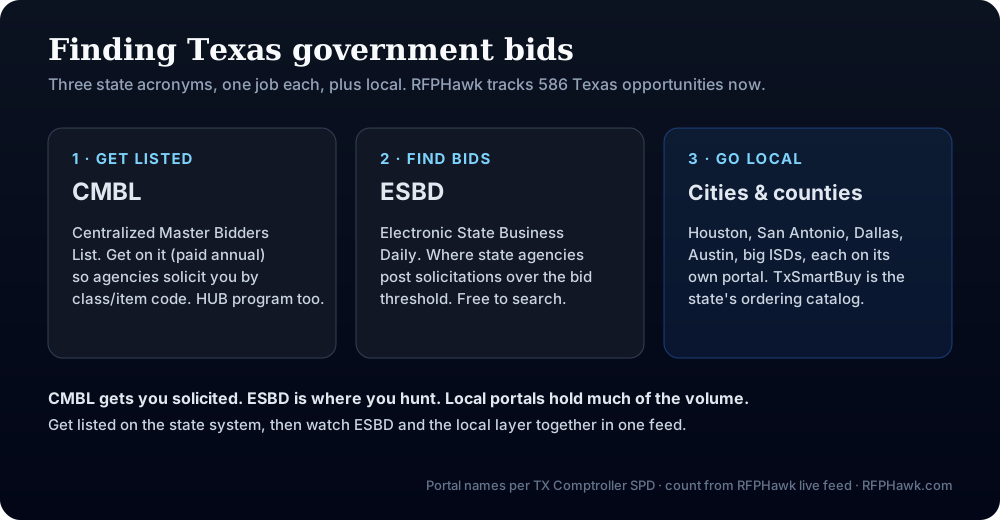
Our feed currently tracks 586 active Texas opportunities across state and local sources, and even that undercounts the independent local portals.
Pro Tip: You can search the ESBD for free without joining the CMBL. Start there to gauge real opportunity volume in your commodity codes before paying the CMBL annual fee.
How do you get listed and certified in Texas?
Two steps put you on agencies’ radar.
- Consider the CMBL. Joining the Centralized Master Bidders List (an annual fee) puts you in the pool agencies use to solicit bids by class and item code. If your work is regularly bought by state agencies, it pays for itself; if you are testing the waters, search the free ESBD first.
- Pursue HUB certification if eligible. The Historically Underutilized Business program certifies businesses owned by economically disadvantaged individuals. Texas agencies have HUB participation goals, so certification improves your visibility, similar to how federal set-aside certifications work.
- Map your codes carefully. Texas uses the NIGP commodity code system. The codes you select drive which solicitations reach you, so pick precisely, as we detail in our multi-state registration guide.
Pro Tip: HUB certification and CMBL listing work together. A HUB vendor on the CMBL, coded accurately, is exactly what an agency looks for when trying to meet its participation goals.
Where do Texas state bids get posted? (The ESBD)
The Electronic State Business Daily is the heart of open Texas state bidding. State agencies must post solicitations above the bid threshold there, and you can search and filter it for free, by agency, by class/item code, and by posting date.
Working the ESBD well is a habit, not a one-time visit. New solicitations appear continuously and proposal windows are finite, so catching one early, rather than the day before it closes, is the difference between a comfortable bid and a scramble. This is exactly what alerts and a filtered feed are for, and it is worth pairing your ESBD checks with a feed that flags new matches automatically.
What about local Texas work?
The state systems are only part of the market. Houston, San Antonio, Dallas, Austin, Fort Worth, El Paso, the big county governments, and the large independent school districts each run their own procurement portals, entirely separate from the ESBD. For many small businesses, this local work is closer, more repeatable, and less crowded than statewide competition.
The approach is the same one we recommend for local government RFPs everywhere: register with your home city or county and the largest nearby districts first, then expand by opportunity volume. Because none of these portals share data with the ESBD or each other, this is precisely where a unified feed saves you from checking a dozen sites by hand.
“In Texas, the ESBD is the statewide stage, but the biggest, steadiest volume for a small firm is often the city, county, and ISD work down the road. Play both.” — the pattern behind many Texas small-business pipelines
Key takeaways
| Point | Details |
|---|---|
| Three systems, three jobs | CMBL to get solicited, ESBD to find bids, TxSmartBuy to sell via catalog |
| ESBD search is free | Gauge volume before paying the CMBL fee |
| HUB helps eligible vendors | State agencies have HUB participation goals |
| Codes drive everything | Texas uses NIGP; pick your class/item codes precisely |
| Local work is huge | Cities, counties, and ISDs each run their own portal |
Why we built RFPHawk for Texas bidders
We built RFPHawk because Texas is the exact fragmentation a feed solves: the ESBD, TxSmartBuy, and hundreds of city, county, and school district portals that never share data. Our feed pulls Texas state and local opportunities into one place, filtered to your commodity codes, so you get listed once on the state system and then watch the whole market from a single list. You can browse live Texas opportunities without an account, check current Texas activity on our state page, and start with a free account that filters everything to your codes and region.
— The RFPHawk Team
Frequently asked questions
Where are Texas government bids posted?
State-agency solicitations above the bid threshold are posted on the Electronic State Business Daily (ESBD). Vendors get solicited directly by joining the Centralized Master Bidders List (CMBL). Texas cities, counties, and school districts post separately on their own portals.
What is the CMBL in Texas?
The Centralized Master Bidders List is Texas’s registered-vendor list, maintained by the Comptroller’s Statewide Procurement Division. Agencies use it to solicit vendors by class and item code. CMBL membership carries an annual fee, unlike simply searching the ESBD, which is free.
What is the Texas HUB program?
The Historically Underutilized Business (HUB) program certifies businesses owned by economically disadvantaged persons and encourages state agencies to include them. HUB certification can improve your visibility and access to Texas state contracting opportunities.
What is TxSmartBuy?
TxSmartBuy is the state’s online ordering system where agencies purchase from established term contracts and catalogs. Winning a spot on a TxSmartBuy term contract lets agencies buy from you directly, separate from responding to individual ESBD solicitations.
How much government work is available in Texas?
A large amount. RFPHawk currently tracks 586 active Texas opportunities across state and local sources, and that undercounts the many independent city, county, and school district portals. Texas is one of the largest government procurement markets in the country.
Recommended
- How to Register on State Procurement Portals — the multi-state registration playbook
- Set-Aside Contracts Explained — how certifications like HUB work
- How to Find Local Government RFPs — reaching the Texas city and county layer
Put RFPHawk to work on your pipeline.
Federal SAM.gov plus a growing list of state portals, refreshed daily and scored against your profile so you see the bids worth pursuing first.
Start free — no credit card