
One of the most freeing ideas in government contracting is that you do not have to win alone. Teaming and subcontracting let a small business perform federal work, and build the past performance that unlocks bigger opportunities, by partnering with firms that already hold contracts or have complementary strengths. If you have looked at a solicitation and thought “we could do part of this but not all of it,” or “we are too new to win this as a prime,” partnership is the answer the guides rarely explain. This article covers the two paths in, subcontracting and teaming, where to find partners, the leverage you did not know you had, and the compliance rules that keep these arrangements legitimate.
Two ways to break in through partnership
There are two distinct partnership paths, and they solve different problems. Subcontracting gets you performing work under someone who already won. Teaming gets you into the bid itself, alongside partners, before award.

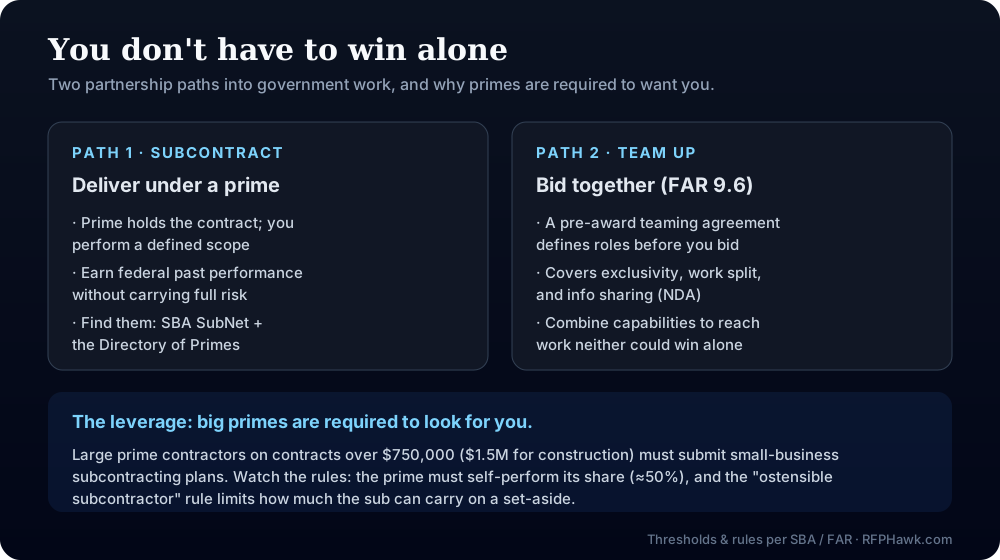
The rest of this guide walks each path, then the leverage and the rules.
Path 1: Subcontracting to a prime
Subcontracting means a prime contractor holds the government contract and hires you to perform a defined portion of the work. For a newer small business, this is the single most accessible entry point, because it requires far less past performance than winning as a prime, and the prime carries the primary contractual risk.
The payoff is the record. Deliver a subcontract well and you earn documented federal past performance, the currency that makes you competitive to bid as a prime later. Many successful contractors started entirely as subs.
Pro Tip: Treat a first subcontract as a past-performance investment, not just revenue. Deliver flawlessly, then ask the prime for a reference and permission to cite the work. That reference is worth more than the margin on the job.
Path 2: Teaming agreements
A teaming agreement is a pre-award arrangement, governed by FAR Subpart 9.6, where two or more companies agree to pursue a specific opportunity together before anyone has won it. It comes in two forms: a joint venture that acts as the prime, or a prime-plus-subcontractor team that bids as a unit.
The point of teaming is capability. Two firms that each hold half of what a solicitation requires can, together, credibly bid work neither could win alone. A good teaming agreement, signed before the bid, defines the relationship so there are no surprises after award.
What a teaming agreement should cover
| Element | Why it matters |
|---|---|
| Roles and scope | Who does which part of the work, in writing |
| Work allocation | The percentage or portion each party performs |
| Exclusivity | Whether the sub is committed to this team only |
| Information sharing | Confidentiality terms for the sensitive data you exchange |
| Post-award terms | The framework for the subcontract if you win |
Pro Tip: Sign the teaming agreement before you invest real proposal hours, not after. The worst time to discover you disagree on work share is the week the award is announced.
The leverage you did not know you had
Here is the part that reframes the whole thing: on large contracts, primes are required to look for small businesses like you.
Large prime contractors (other than small businesses) receiving contracts above $750,000, or $1.5 million for construction, must submit small-business subcontracting plans and make good-faith efforts to meet them, per SBA guidance. That means the demand for capable small-business subcontractors is not a favor you are asking, it is a requirement the prime is trying to meet. You are the solution to their compliance problem.
Two free tools connect you to that demand:
- SBA’s SubNet lists subcontracting opportunities that primes post, searchable by NAICS code. Some are reserved for small business.
- The Directory of Federal Prime Contractors with Subcontracting Plans lets you identify primes with plans to fill, so you can approach them directly through their vendor process.
Approach a prime the way you would approach any customer: with a targeted capability statement showing exactly the scope you can take off their plate.
What are the rules you have to respect?
Partnership has guardrails, and crossing them can disqualify a bid or an entire set-aside. Know these before you sign anything.
The ostensible subcontractor rule. On a small-business set-aside, the small-business prime must genuinely lead. Under SBA’s affiliation rules, if the subcontractor performs the vital requirements, or the prime is unusually reliant on it, the arrangement can be found ineligible for the set-aside. Teaming cannot be a way to front for a larger firm.
Limitations on subcontracting. A small-business prime generally must self-perform a minimum share of the work: for service contracts, at least 50% of the personnel cost with its own employees; for supplies, at least 50% of the value. The prime cannot simply pass the whole job through.
Recertification and eligibility changes. Size and eligibility rules evolve, and mergers or acquisitions can change a firm’s small-business status for future work. If you are teaming for the long term, keep an eye on current SBA rules rather than assuming today’s status is permanent.
“Teaming is a genuine partnership, not a costume. The rules exist to keep set-asides going to the businesses they are meant for, and the firms that respect them build reputations primes want to work with again.” — a principle every compliant teaming relationship shares
How do you find and win partners?
Partnership is business development like any other. A simple approach works.
- Identify the primes in your lane. Use SubNet and the Directory to find primes winning work in your NAICS codes, and note who has subcontracting plans to fill.
- Lead with the scope you own. Do not ask to “partner”; offer to take a specific, well-defined piece of work off their plate. Specificity wins.
- Bring your record. A tight capability statement and any past performance, even commercial, makes you a lower-risk choice.
- Watch for pre-award signals. Sources sought notices often invite teaming interest before a solicitation, the ideal moment to get on a team.
- Get it in writing early. Once you agree to pursue something together, sign a teaming agreement before the proposal work begins.
Key takeaways
| Point | Details |
|---|---|
| You do not have to win alone | Subcontracting and teaming are legitimate ways in |
| Subcontracting builds the record | Less past performance required; earns the record primes and agencies want |
| Teaming is a pre-award partnership | FAR 9.6; define roles, work share, and confidentiality before bidding |
| Primes are required to want you | Big-contract primes must have small-business subcontracting plans |
| Respect the rules | Ostensible subcontractor rule and 50% self-performance keep it legitimate |
Why partnership fits how we think about the market
We built RFPHawk on the idea that a small business should compete on preparation and fit, not size, and partnership is the clearest expression of that. Watching the same feed that surfaces open solicitations also surfaces the sources sought notices where teaming often begins, and the awards that tell you which primes are winning work you could support. You can browse the live feed without an account, and a free account filters everything to your industry and region, so whether you are hunting a bid to win or a prime to join, you are working from the same focused, relevant list.
— The RFPHawk Team
Frequently asked questions
How do small businesses get government subcontracts?
Find prime contractors who need subcontractors through SBA’s SubNet and the Directory of Federal Prime Contractors with Subcontracting Plans, then approach them directly with a targeted capability statement. Large primes on big contracts are required to have subcontracting plans, so the demand for small-business subs is built in.
What is a teaming agreement?
A teaming agreement is a pre-award contract between a prime contractor and one or more partners that defines each party’s role, work share, and terms before they bid together on a specific opportunity. It is governed by FAR Subpart 9.6 and typically covers exclusivity, scope, and confidentiality.
What is the difference between subcontracting and teaming?
Subcontracting means delivering a defined scope under a prime who holds the contract. Teaming is a broader pre-award arrangement to pursue an opportunity together, either as a joint venture acting as prime or as a prime-plus-subcontractor team. Teaming is planned before the bid; subcontracting can also happen after award.
What is the ostensible subcontractor rule?
It is an SBA rule that limits how much of a set-aside contract a subcontractor can perform. If the subcontractor performs the vital requirements, or the prime is unusually reliant on it, the arrangement can be deemed ineligible for the small-business set-aside. It protects the integrity of set-aside programs.
Do you need past performance to subcontract?
Less than you need to win as a prime, which is exactly why subcontracting is a strong entry point. A prime is often willing to bring on a capable sub for a defined scope, and that work then becomes the federal past performance that makes you competitive to bid as a prime yourself.
Recommended
- How to Win Your First Government Contract — where partnership fits the bigger roadmap
- How to Write a Capability Statement — what you send a prime to get on their team
- What Is a Sources Sought Notice — where teaming often begins, before the RFP
Put RFPHawk to work on your pipeline.
Federal SAM.gov plus a growing list of state portals, refreshed daily and scored against your profile so you see the bids worth pursuing first.
Start free — no credit card