
Ask how long it takes to win a government contract and you will hear everything from “a few weeks” to “give it three years.” Both can be true, which is exactly why the question confuses so many newcomers into quitting before they start. The honest answer is that government contracting timelines are a spectrum, not a single number: a micro-purchase can be awarded in days, a standard competitive contract runs a couple of months from solicitation to award, and a large, complex procurement genuinely can take six months or more. This guide lays out the real timeframes for each phase, shows you where the fast wins live, and busts the “it takes forever” myth that keeps capable businesses on the sidelines.
The myth, and the reality
The belief that government contracting takes years comes from looking at the slowest possible example, a major, complex, heavily-evaluated federal award, and treating it as the norm. It is not. Most of the market moves faster than that, and the parts that move fastest are exactly where a new contractor should begin.
Here is the whole picture on one line, from fastest to slowest.
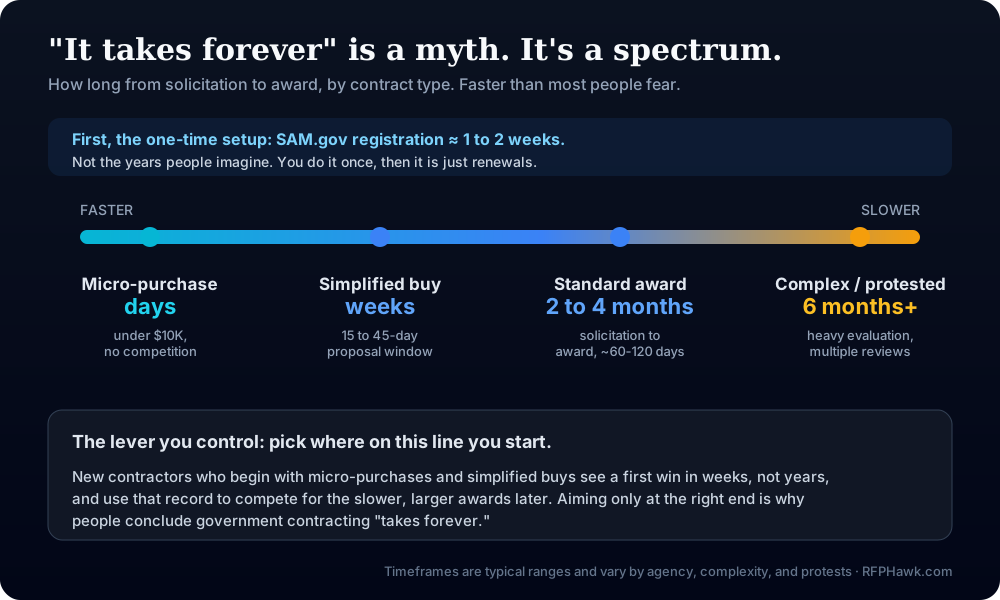
The lever you control is where on that line you choose to start. Aim only at the far right, and yes, it takes forever. Start at the left, and you can have a first win, and the past performance that comes with it, in weeks.
How long does the one-time setup take?
Before any of the above, there is a one-time setup, and it is far shorter than its reputation. Registering on SAM.gov, which is mandatory and free for federal work, typically takes about one to two weeks when your documentation is in order, occasionally stretching toward a month if entity validation hits a snag. After that it is just an annual renewal.
Add your state vendor registrations (each roughly a same-day form, covered in our multi-state registration guide) and your setup is measured in weeks, not years. The paperwork barrier people dread is real but small, and you clear it once.

Pro Tip: Start your SAM.gov registration the day you decide to pursue government work, before you find a specific opportunity. The one-to-two-week clock should run in the background while you learn the market, not after you have found a bid with a deadline.
What is the timeline once you find an opportunity?
Once a solicitation is live, the clock has two parts: the time you get to respond, and the time the agency takes to award.
Your proposal window is set by the solicitation. Simplified acquisitions may give you 15 to 20 days; standard competitive solicitations usually allow 30 to 45; complex requirements can run 60 to 90. This is why seeing opportunities early matters so much, a 30-day window you catch on day 2 is comfortable, while the same window caught on day 25 is a scramble.
The agency’s award timeline is the part you do not control. For a straightforward competitive contract, expect roughly 60 to 120 days from solicitation to award. Evaluation alone can run from a few weeks to several months, and final reviews, approvals, and any protest periods add more.
Government contract timeline by type
| Contract type | Typical time to award | Competition |
|---|---|---|
| Micro-purchase (under $15K) | Days | None required |
| Simplified acquisition | A few weeks | Streamlined |
| Standard competitive | 60 to 120 days | Full |
| Complex / large / protested | 6 months or more | Full, heavy evaluation |
Where are the fast wins?
If speed matters to you, and for a new contractor building momentum it should, aim deliberately at the fast end.
- Micro-purchases (federal buys under $15,000, up from $10,000 since October 2025) require no formal competition and are awarded quickly. They are the single fastest path to a first win, and we make the case for starting here in our first-contract guide.
- Simplified acquisitions compress the whole process, shorter proposal windows and faster evaluation, in exchange for smaller dollar values.
- Local and state work often moves faster than federal, with less competition and lighter evaluation than a national solicitation.
The strategic point: a first win at the fast end buys you the past performance that makes you competitive for the slower, larger awards. You are not choosing small forever, you are choosing to start where the clock is kind.
“Speed in government contracting is a choice you make at the target-selection stage. Pick fast-moving work first, and the market feels responsive. Pick only the biggest awards, and it feels frozen.” — a lesson most successful contractors learn early
How do you make the timeline work for you?
You cannot speed up an agency’s evaluation, but you control three things that decide whether the timeline feels workable or brutal.
- Run the setup clock early. Get SAM.gov and your state registrations done before you need them, so the one-to-two-week wait never sits between you and a live bid.
- See opportunities on day 1, not day 25. The single biggest timeline lever is catching a solicitation early, which turns a tight proposal window into a comfortable one. This is what alerts and a filtered feed are for.
- Match target to urgency. Need revenue soon? Bid micro-purchases and simplified acquisitions. Building a long-term pipeline? Layer in the slower, larger awards, knowing they pay off months out.
Reactive vs. prepared timeline
| Reactive | Prepared | |
|---|---|---|
| Setup | Started after finding a bid; delays you weeks | Done in advance; zero delay |
| Proposal window | Caught late; a scramble | Caught early; comfortable |
| First win | Distant; discouraging | Weeks away at the fast end |
Key takeaways
| Point | Details |
|---|---|
| It is a spectrum, not “years” | Days for micro-purchases, 2 to 4 months for standard awards |
| Setup is weeks, not years | SAM.gov ≈ 1 to 2 weeks, one time, then annual renewal |
| You control the response clock | Catching a bid early turns a tight window into a workable one |
| Fast wins live at the small end | Micro-purchases and simplified buys award quickly |
| Start fast, grow slow | Early wins buy the past performance the big, slow awards require |
Why early visibility is the real timeline lever
We built RFPHawk because the one part of the timeline you can actually influence is when you find out. An agency’s evaluation takes what it takes, but a proposal window you catch on day 1 instead of day 20 changes everything about how the process feels. Our feed pulls federal and state opportunities into one place, filtered to your industry and location, so the fast-moving work you can win quickly reaches you while there is still time to bid it well. You can browse the live feed without an account, and a free account filters everything to your NAICS codes and region, so the clock is on your side from day one.
— The RFPHawk Team
Frequently asked questions
How long does it take to win a government contract?
It depends on the contract type. Micro-purchases under $15,000 can be awarded in days, simplified acquisitions in a few weeks, and standard competitive contracts typically 60 to 120 days from solicitation to award. Complex or protested procurements can take six months or more.
How long does SAM.gov registration take?
SAM.gov registration usually takes about one to two weeks when your documents are in order, though it can stretch toward a month if validation issues arise. It is a one-time setup, renewed annually, not the multi-year barrier newcomers often imagine.
How long do you get to submit a proposal?
Proposal windows vary by procurement. Simplified acquisitions may give 15 to 20 days, standard solicitations typically 30 to 45 days, and complex requirements 60 to 90 days. Seeing opportunities early is what turns a tight window into a workable one.
What is the fastest way to win a first government contract?
Target micro-purchases and simplified acquisitions. Micro-purchases under $15,000 require no formal competition and are awarded quickly, making them the fastest path to a first win and the past performance that speeds up everything after.
Why do people think government contracting takes forever?
Because they aim only at large, complex federal awards, which genuinely take six months or more. That single data point becomes the whole story. In reality the timeline is a spectrum, and the fast end is where new contractors should start.
Recommended
- How to Win Your First Government Contract — where the fast wins live
- How Much Does It Cost to Bid on Government Contracts? — the other half of the “is it worth it” question
- How to Set Up Government RFP Alerts — catch bids on day 1, not day 25
Put RFPHawk to work on your pipeline.
Federal SAM.gov plus a growing list of state portals, refreshed daily and scored against your profile so you see the bids worth pursuing first.
Start free — no credit card