
If you have priced GovWin IQ alternatives, it is probably because you hit the sales call and the sticker shock in the same week. GovWin IQ is Deltek’s market-intelligence platform for government contractors, and it is genuinely powerful, but Deltek does not publish pricing, and buyer data puts the average contract around $29,000 a year. That is more than many small businesses clear on their first government contract. This guide compares the real alternatives, from free portals to sub-$200 tools to mid-market platforms, so you can match what you pay to what you actually bid. Our angle is simple: most small firms do not need market intelligence, they need a filtered feed of open opportunities with deadlines they will not miss.
What GovWin IQ costs, and what you actually get
GovWin IQ is not a bid board, it is a capture-planning platform. According to buyer-side pricing data published by Vendr, annual contracts range from $13,000 to $119,000, with the average deal around $29,000. Deltek quotes each customer based on seats, modules, and contract length, which is why you will not find a price on the website.
For that money you get things the cheaper tools genuinely do not have: pre-RFP forecasts of opportunities agencies have not posted yet, dedicated analyst research, teaming and competitor data, and agency spending analysis. Industry reviewers also consistently note the costs around the subscription itself, with onboarding for smaller teams commonly reported at $1,000 to $5,000 and annual contracts that auto-renew unless cancelled with written notice well in advance.

The alternatives at a glance
| Tool | Coverage | Price | Best for |
|---|---|---|---|
| GovWin IQ (Deltek) | Federal + SLED + forecasts | Unpublished; reported $13,000–$119,000/yr | Capture teams planning years ahead |
| GovTribe | Federal, state add-on | Listed $1,350–$4,000/yr | Solo federal-focused capture |
| EZGovOpps | Federal + SLED | Listed from $2,695/yr | Small capture teams wanting analyst support |
| BidNet Direct | State & local | Per-state plans, billed annually | Multi-state local bidding |
| SAM.gov | Federal only | Free | The required federal baseline |
| State portals | One state each | Mostly free | Home-state work |
| RFPHawk | Federal + state, one feed | Free tier; Pro $20/mo ($16/mo annual) | Small businesses that need discovery + alerts |
Where a vendor does not publish pricing, figures are buyer-reported estimates and are marked as such. Listed prices were checked July 2026.
Put the annual cost on one axis and the gap is hard to unsee:
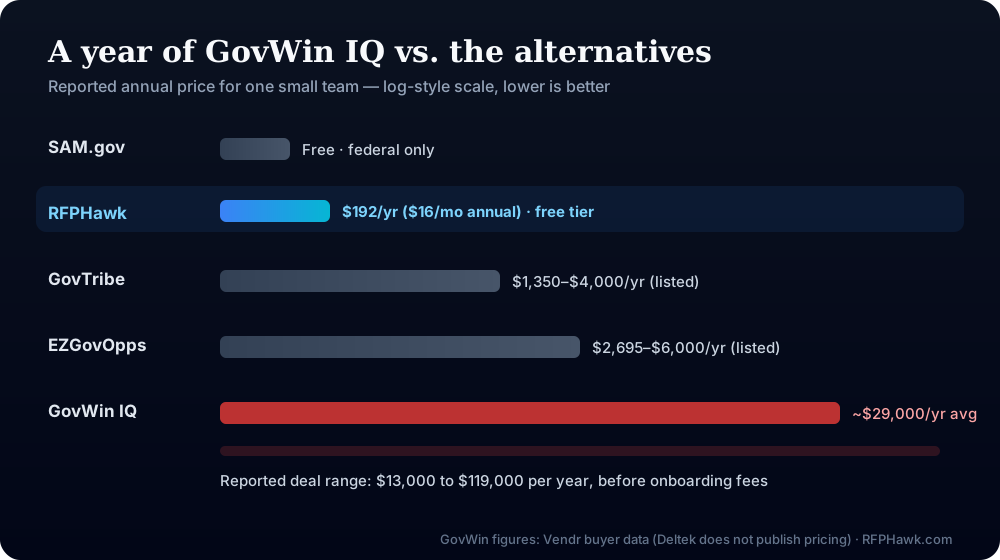
The U.S. Small Business Administration’s contracting guidance tells new contractors to start with the free registrations and portals before spending on tools, and that ordering is right. The question is not “is GovWin IQ good,” it is “does the next $29,000 of tooling win you more than $29,000 of margin.” For a firm chasing $50,000 to $500,000 contracts, it usually does not.
Pro Tip: Ask any enterprise vendor for the price of exactly one seat with no analyst modules. If the answer still needs a discovery call, the product is built for a budget bigger than yours.
How do you choose a GovWin IQ alternative?
The right pick depends on what you bid, where you bid, and who does the bidding. Work through it in this order.
- Count your markets. Federal only? SAM.gov plus a federal-focused tool like GovTribe covers you. State and local too? You need something that aggregates beyond SAM.gov, because state and local agencies post on hundreds of separate portals.
- Count your seats. Per-seat enterprise pricing punishes one-person shops. A solo owner doing business development part-time should be paying flat, low pricing, not a per-seat rate designed for a 20-person capture team.
- Decide if you need forecasts or feeds. Pre-RFP intelligence matters when you shape deals years out. If you respond to posted solicitations, a well-filtered feed of open opportunities is the whole job.
- Check the match quality, not the listing count. A database with 100,000 listings and no scoring wastes more of your week than a scored feed. Look for filtering by industry, geography, and deadline. RFPHawk’s live feed currently tracks 37,550 solicitations, 28,074 of them active, and its whole design bet is that scoring beats volume.
- Insist on alerts. Discovery you have to remember to do is discovery that stops happening in a busy month. Daily or weekly digests are the feature that actually compounds. (We wrote a full guide on setting up government RFP alerts.)
- Test before you sign. GovTribe lists a 14-day trial, EZGovOpps a 5-day one, and you can browse RFPHawk without an account. Run your real NAICS codes and region through each and count the opportunities you would genuinely bid.
- Read the renewal terms. Annual contracts with advance-notice cancellation windows are standard at the enterprise tier. Know the notice period before you sign, not eleven months later.
Pro Tip: Run the same one-week test in every tool you trial: your real codes, your real states, and a count of bids you would actually submit. The winner is the tool with the best “would bid” count per dollar, not the biggest database.
What goes wrong when small firms buy enterprise intelligence?
Most regret in this category comes from three predictable mistakes.
Paying for a research department you do not have. GovWin IQ’s forecasts, analyst calls, and spending analytics assume someone on your team spends their week on capture strategy. In a five-person company, nobody does. The features are real; the hours to use them are not.
- If no one owns “pipeline two years out,” forecasts go unread.
- If you have never called an analyst, you will not start because you bought access.
- If your bid decisions take an afternoon, not a quarter, you are a feed customer, not an intelligence customer.
Confusing coverage with fit. Every vendor advertises how many opportunities they index. The number that matters is how many fit your business this month, and that is a filtering question, not a coverage question.
Skipping the free baseline. Some firms buy tooling before they have exhausted SAM.gov and their home-state portal, both free. Do the free setup first, then pay only to close the gaps it leaves: cross-portal aggregation, filtering, and alerts.
“Concentrate on tools that help you respond to real solicitations before you invest in tools that help you predict future ones. Cash flow comes from posted bids.” — a paraphrase of the standing advice in the SBA’s federal contracting guide for small businesses
Which alternative fits which business?
There is no single best GovWin IQ alternative, there are four honest tiers. Match yours to how you actually sell.
| Your situation | Right tier | What to use |
|---|---|---|
| Brand new, first bid ahead | Free | SAM.gov + your state portal, checked weekly |
| Bidding regularly, one owner-operator | Low-cost feed | RFPHawk Pro ($20/mo) or similar: one feed, scoring, digests |
| Federal-only, full-time BD person | Mid-market | GovTribe or EZGovOpps ($1,350–$6,000/yr) |
| Multi-year capture, dedicated team | Enterprise | GovWin IQ, if the contract sizes justify it |
The tiers stack rather than replace each other. Plenty of firms keep SAM.gov saved searches running alongside a paid feed, and a firm that graduates to enterprise intelligence still needs the daily bid feed underneath it. If you sell into a specific vertical, browse the current volume in your space on our industry pages before deciding what coverage is worth paying for.
Key takeaways
Five things to hold onto from this comparison.
| Point | Details |
|---|---|
| GovWin IQ pricing is real money | Unpublished by Deltek; buyer data reports $13,000–$119,000/yr, ~$29,000 average |
| Intelligence and discovery are different products | Forecasts and analysts serve capture teams; feeds and alerts serve bidders |
| Free covers more than vendors admit | SAM.gov + state portals are the legitimate $0 baseline |
| Fit beats coverage | Judge tools by “bids you would submit per week,” not listings indexed |
| Match spend to contract size | A $29,000 tool chasing $100,000 contracts has to be nearly infallible to pay for itself |
Why we think most small firms need a feed, not a forecast
We have watched a lot of small contractors shop this category, and the pattern repeats: they price GovWin IQ because it is the name they have heard, discover the cost, and assume serious contracting requires enterprise spend. It does not. The work a small business can actually win this quarter is posted, open, and closing within weeks, exactly the kind of solicitation a filtered feed surfaces and a forecast module ignores.
Enterprise intelligence is a real product for real buyers. But the jobs that decide whether a five-person firm wins government work are unglamorous: see every relevant open bid across the portals you would never check by hand, know which ones fit, and never miss a deadline. Those jobs cost hundreds a year to solve, not tens of thousands.
“Buy the tool that makes Tuesday morning faster. The strategy platforms can wait until you have a strategist.” — The RFPHawk Team
RFPHawk for teams priced out of GovWin IQ
If the sales quote sent you here, the honest comparison is this: RFPHawk does not do pre-RFP forecasts or analyst calls, and does not try to. It watches federal and state portals, currently 37,550 tracked solicitations with 28,074 active, filters them to your industry and location, and emails you the new matches every morning. You can browse the live feed right now without an account, and a free account lets you search and filter with no credit card. Pro, which adds match scoring, saved searches, daily digests, and pipeline tracking, is $20 a month, or $16 a month billed annually. That is about $240 a year, under one percent of the average reported GovWin IQ contract.
Frequently asked questions
How much does GovWin IQ cost?
Deltek does not publish GovWin IQ pricing. Buyer data reported by Vendr puts annual contracts between $13,000 and $119,000, with the average deal around $29,000 per year. Onboarding fees for smaller teams are commonly reported at $1,000 to $5,000 on top.
Is GovWin IQ worth it for a small business?
Usually not at first. GovWin IQ earns its price for capture teams planning bids years ahead with analyst support and pre-RFP forecasts. A small business bidding this quarter mostly needs discovery, filtering, and alerts, which cheaper tools cover for under $200 a year.
What is the best free alternative to GovWin IQ?
SAM.gov is the free federal baseline, and most states run free procurement portals. Together they cover discovery but offer no unified feed, match scoring, or cross-portal alerts. RFPHawk’s free tier adds a single searchable feed across federal and state sources.
What are the cheapest paid GovWin IQ alternatives?
RFPHawk Pro runs $20 per month, or $16 per month billed annually. GovTribe lists federal plans from $1,350 per year, EZGovOpps starts at $2,695 per year, and BidNet Direct prices per state. All cost a small fraction of a typical GovWin IQ contract.
What does GovWin IQ include that alternatives don’t?
Pre-RFP opportunity forecasts, dedicated analyst research, teaming partner data, and agency spending analysis. Those capture-planning features are real, but they are built for firms pursuing large, multi-year contracts, not for finding and bidding open solicitations.
Recommended
- The Best RFP Databases for Small Businesses — the wider comparison this article drills into
- How to Set Up Government RFP Alerts — the alerts workflow any tool should feed
- How to Bid on State Contracts — the state-and-local side GovWin charges most for
Put RFPHawk to work on your pipeline.
Federal SAM.gov plus a growing list of state portals, refreshed daily and scored against your profile so you see the bids worth pursuing first.
Start free — no credit card