
Searching for a BidNet Direct review usually means one of two things happened: an agency you sell to told you to register there, or a salesperson quoted you a subscription and you want a second opinion before signing. Both deserve a straight answer, and they are actually different questions, because BidNet Direct is two products wearing one name: the official posting platform for a large network of state and local agencies, and a paid notification service layered on top. This review takes them separately: what the free registration genuinely gets you, what the paid packages reportedly cost, where users say the platform frustrates, and who comes out ahead paying versus covering the same ground another way.
What BidNet Direct is, and why some vendors have no choice
BidNet Direct, operated by mdf commerce (rebranding under the SOVRA name), runs regional purchasing groups across all 50 states that more than 1,500 local governments use as their official solicitation platform. New York’s Empire State Purchasing Group alone counts over 200 participating agencies, and the Rocky Mountain E-Purchasing System plays the same role for Colorado and Wyoming.
That first half matters more than any review score: if your county, school district, or city posts through a BidNet purchasing group, that is where the documents live, where addenda publish, and often where responses are submitted. Registering, at minimum on the free tier, is not a purchasing decision. It is table stakes for those agencies, the same way SAM.gov registration is table stakes for federal work.

The second half, the subscription, is where the buying decision actually lives, so the rest of this review is about that.
BidNet Direct at a glance
| The free Limited registration | The paid packages | |
|---|---|---|
| Access to participating agencies’ bids | Yes | Yes |
| Automated email notifications | No | Yes, matched to your codes |
| Addenda alerts | Manual checking | Included |
| Advanced + saved search | No | Yes |
| Coverage | Agencies you select | Per-state packages, tiered |
| Reported price | $0 | ~$9–$45 per state, per month, billed annually |
BidNet Direct quotes pricing on request; figures are reported by third-party review sites (Research.com, GetApp, SaaSworthy, 2026) and vary by package tier: group agencies, state and local, or federal plus state and local.
What does BidNet Direct do well?
Judged as an official posting platform, BidNet Direct is genuinely useful, and in its strongholds it is simply where the work is.
- It is the source, not a scraper, for its network. For participating agencies, postings, documents, and addenda appear there first because that is where buyers create them. No aggregator can beat the primary source on those agencies.
- Regional depth in its strong states. In purchasing-group strongholds like New York, Colorado, Michigan, and Florida, the local and county coverage runs deeper than federal-focused tools bother to go.
- Paid notifications work when configured tightly. Matched to specific 5-digit NIGP commodity codes, the alert emails do the daily checking for you across every agency in your package.
- Some agencies sponsor vendor access. Where an agency covers the cost, you get notification benefits on their solicitations without paying yourself. Worth checking before buying anything.
Pro Tip: Before you evaluate BidNet as a paid product, make a list of the 10 agencies you most want to sell to and find where each actually posts. If most post through a BidNet group, the free registration is mandatory anyway and the paid question becomes a simple upgrade decision.
How do you set up BidNet Direct without regretting it?
Most BidNet frustration is avoidable at setup. If you are going to register, free or paid, do it in this order.
- Map your buyers first. List the agencies you actually want to sell to and check each one’s purchasing page for where it posts. This tells you whether BidNet is mandatory, optional, or irrelevant for you before any account exists.
- Start with the free Limited registration. It costs nothing, gets you document access on participating agencies, and lets you judge real opportunity volume in your codes before a salesperson does the judging for you.
- Choose 5-digit NIGP codes, not 3-digit categories. This is the single decision that separates useful alerts from the inbox flood users complain about. Tight codes, then widen only if you are missing work.
- Select agencies deliberately. Add the governments you mapped in step 1 rather than everything in the region. You can expand later; recovering from over-subscription is what churns people out.
- Ask about agency-sponsored access. Some agencies cover vendor notification benefits on their own solicitations. One email to the purchasing office can save you the subscription question entirely.
- Run 30 days of manual checking before upgrading. Count the real, biddable matches the free tier surfaced. That number, times your win rate and margin, is what the paid tier’s alerts are worth to you. (The same test works on any tool; we walk through it in our RFP alerts guide.)
- If you do buy, calendar the renewal. Reviewers report auto-renewal with email-only cancellation. Whatever your order form says, put the notice deadline in your calendar the day you sign.
Pro Tip: Volume test any paid tier the same way: real matches per month, times your historical win rate, times average contract margin. If that number is not comfortably above the subscription price, the tool is a cost, not an investment.
Where does BidNet Direct fall short?
The consistent complaints, across review sites and user forums, cluster in four places.
The free tier withholds the one thing you wanted. Limited registration gets you in the door, but automated notifications, the entire point of a bid service, are paid. Free users must log in and manually check each agency’s postings, which is the chore you were trying to eliminate.
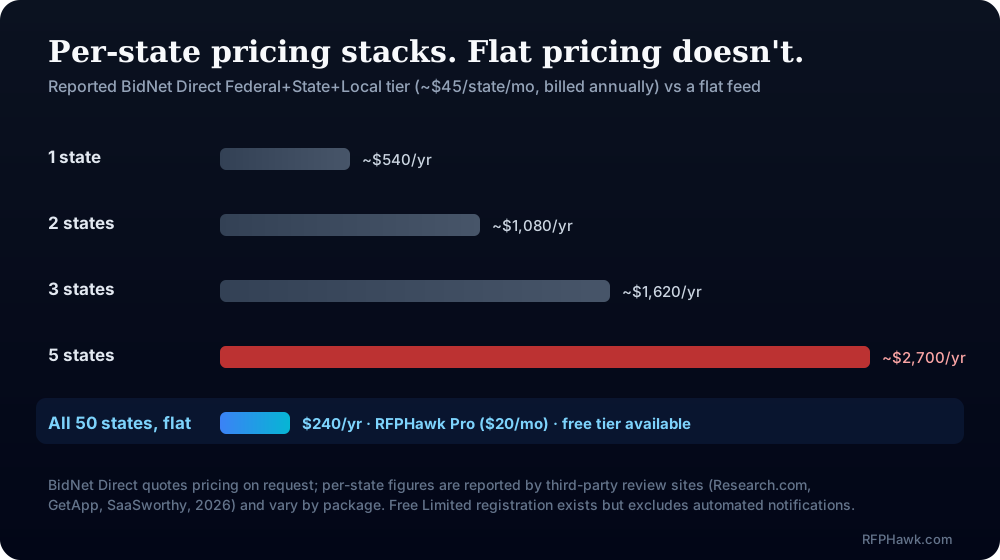
Per-state pricing punishes growth. The reported packages price per state. One state at the reported top tier runs about $540 a year, which is reasonable. Five states runs about $2,700 a year for coverage a flat-priced tool provides for a tenth of that. The math turns against you exactly when your business starts expanding.
Notification overload with sloppy setup. The most common user complaint pattern is broad category codes producing dozens of irrelevant emails a day. The fix is choosing tight 5-digit NIGP codes, but the platform defaults do not protect you from yourself.
Renewal and interface friction. Reviewers describe subscriptions that renew automatically with cancellation handled by email rather than a dashboard button, and an interface that, in Research.com’s polite phrasing, has not kept pace with modern software. Read your order form’s renewal terms before signing; on reported terms, calendar the notice window.
“The best bid platform is the one your buyers actually post on. Every other feature is negotiable; that one is not.” — the test we apply to every tool in this category, our own included
So is BidNet Direct worth paying for?
It depends almost entirely on your footprint. The honest decision table:
| Your situation | Verdict | Why |
|---|---|---|
| Your target agencies post through a BidNet group | Register free, regardless | It is their official platform; you need the access |
| Deep in ONE BidNet-heavy state (NY, CO, MI, FL…) | Paying is defensible | ~$540/yr reported for primary-source alerts on deep local coverage |
| Bidding in 2+ states | Look at flat-priced tools first | Per-state stacking outruns flat pricing fast |
| Federal work is your focus | Skip the paid tier | SAM.gov is free and BidNet’s value is state/local |
| You need alerts but have almost no budget | Free Limited + SAM.gov saved searches | Covers the baseline at $0, with manual checking as the cost |
For the multi-state and budget rows, the alternative worth pricing is a flat-fee aggregator. RFPHawk watches federal plus state sources across all 50 states for $20 a month flat ($16 a month billed annually), with match scoring and morning digests on Pro; the trade-off runs the other way, since we aggregate what agencies post rather than being the official submission platform for anyone. Plenty of vendors sensibly run both: free BidNet registrations where their agencies require it, a flat feed for discovery everywhere.
Key takeaways
| Point | Details |
|---|---|
| BidNet is two products | An official posting platform (often unavoidable) and a paid alert service (optional) |
| The free tier is access, not automation | No notifications on Limited; manual checking required |
| Reported pricing is per state | ~$9–$45/state/month billed annually; quotes on request |
| Strongest where it is the source | NY, CO, MI, FL purchasing groups and 1,500+ local governments |
| Multi-state vendors should compare flat pricing | Per-state costs stack; $2,700/yr for 5 states vs $240/yr flat elsewhere |
Why we review competitors at all
We build a competing product, so you should discount our conclusions accordingly, and we will keep handing you the discount rate: BidNet Direct is the primary source for its network, and no aggregator, us included, beats the primary source on those agencies. What we can do is what per-state platforms cannot: one flat price for every state at once, scored against your profile. That is a different job, and this whole series (the databases landscape, the free sites, the enterprise tier) exists so you can match the job to the tool instead of buying whichever one found you first.
— The RFPHawk Team
Frequently asked questions
Is BidNet Direct legitimate?
Yes. BidNet Direct operates official regional purchasing groups used by over 1,500 local governments across the country, including the Empire State Purchasing Group in New York. For many participating agencies it is the official place solicitations get posted.
How much does BidNet Direct cost?
BidNet Direct quotes pricing on request rather than publishing it. Third-party review sites report per-state packages of roughly $9 to $45 per state per month depending on coverage level, billed annually. A free Limited registration also exists.
Is BidNet Direct free?
There is a free Limited registration that lets you access participating agencies’ bids, and some agencies cover vendor access. The free tier does not include automated bid notifications, advanced search, or saved searches; those are part of the paid packages.
Do I have to register on BidNet Direct?
If an agency you sell to posts its solicitations through a BidNet purchasing group, then yes, registering (at least the free tier) is effectively required to see documents and respond. Check where your target agencies actually post before deciding.
What is the difference between BidNet Direct and SAM.gov?
SAM.gov is the federal government’s own free posting site. BidNet Direct is a private platform (mdf commerce) that hosts state and local purchasing groups and sells vendors aggregated access and notifications across them. They cover mostly different opportunities.
Recommended
- Best Free Government Bid Sites — the $0 baseline, including BidNet’s free tier fine print
- GovWin IQ Alternatives — the enterprise end of the same decision
- How to Bid on State Contracts — what to do once you can see the bids
Put RFPHawk to work on your pipeline.
Federal SAM.gov plus a growing list of state portals, refreshed daily and scored against your profile so you see the bids worth pursuing first.
Start free — no credit card