On July 4, 2026, the United States turns 250 years old. It’s a milestone worth pausing on — and, for the small businesses that make up so much of the American economy, it’s also a reminder of a quieter tradition that’s nearly as old as the country itself: private businesses supplying their government. Long before there was a SAM.gov or a single RFP, there were American merchants and artisans answering their new nation’s call for muskets, uniforms, and bread. This Independence Day, it’s worth looking at how that relationship began, how it grew into a $700-billion-a-year market, and what 250 years of it means for a small business owner today.
Government contracting is almost as old as the Declaration
The Continental Congress was awarding contracts before the United States even existed as a country. To field an army against the British, it turned to private merchants, gunsmiths, tailors, and farmers — because the fledgling government made almost nothing itself. Gunpowder, muskets, uniforms, wagons, and provisions all came from private hands, often on credit and often at great personal risk to the suppliers. The Revolution was won, in no small part, by small businesses.
The young republic kept relying on private enterprise. In January 1798, with war against France looming, the War Department awarded Eli Whitney a contract for 10,000 muskets — and Whitney used it to champion the then-radical idea of interchangeable parts, a concept that would eventually reshape American manufacturing. Whether he fully delivered on it is debated by historians, but the pattern was set: the government named what it needed, and private business figured out how to build it. That bargain has held for two and a half centuries.
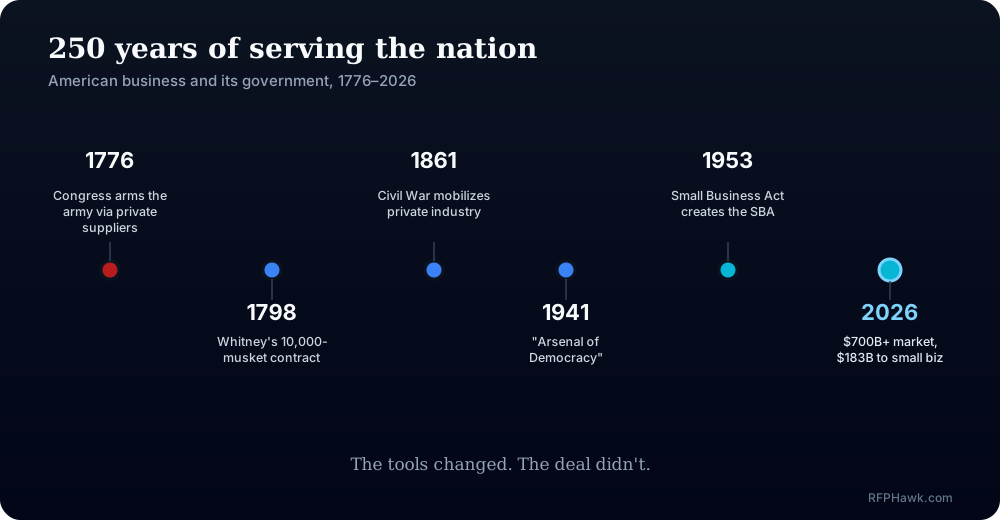
| Year | Milestone |
|---|---|
| 1775–76 | Continental Congress contracts private suppliers to arm and feed the army |
| 1798 | Eli Whitney’s 10,000-musket federal contract popularizes interchangeable parts |
| 1861 | The Civil War mobilizes private industry at unprecedented scale |
| 1941 | WWII makes American industry the “Arsenal of Democracy” |
| 1953 | The Small Business Act creates the SBA and small-business contracting goals |
| 2026 | 250 years on: a $700B+ market, a record share going to small firms |
The through-line is clear when you lay it out.
Why the government reserves work for small businesses
For most of American history, government buying favored whoever was biggest. That changed in 1953, when Congress passed the Small Business Act, created the Small Business Administration, and established a principle that still governs federal buying: a fair proportion of contracts should go to small businesses. It was, in its way, a very American idea — that opportunity to serve the nation shouldn’t be reserved for the largest players.
That principle is carried out today through set-aside programs that reserve certain contracts for specific kinds of small firms — the 8(a), WOSB, HUBZone, and SDVOSB programs chief among them. They exist because a competitive industrial base and a broad distribution of opportunity are treated as national interests, not just economic ones. The country decided, deliberately, that the corner IT shop and the veteran-owned construction firm deserved a real shot at the work.
How big is the opportunity today?
Very. The federal government spends well over $700 billion a year buying goods and services from private companies, and the small-business share has been climbing to record highs. In fiscal 2024, the government awarded a record $183 billion in contracts to small businesses — more than a quarter of all eligible contract dollars, comfortably above the 23% goal.
And that’s just the federal figure. Add state and local government — a combined $2 trillion-plus a year — and the opportunity for a small business willing to learn the ropes is enormous. The work is real and it’s everywhere: someone maintains the grounds at the VA hospital, someone paves the county road, someone supplies the school district’s computers. Increasingly, that someone is a small business.
If you’re wondering where to even begin, our complete guide to finding government RFPs is the place to start.
Serving the country, one contract at a time
It’s easy to think of government contracting as dry — forms, codes, portals. But step back on a day like today and the picture is different. Every contract is a small business doing something the country needs done: feeding service members, building infrastructure, keeping the lights on at a federal building, delivering the software an agency runs on. It’s participation in the republic, paid honestly for honest work.
That’s not a small thing. When a family-owned company wins its first county contract, or a veteran-owned firm lands a federal task order, they’re joining a line that runs unbroken back to the merchants who armed the Continental Army. The tools have changed — muskets became microchips, and hand-carried bids became online portals — but the deal is the same one struck in 1776: a nation of citizens, doing business with the government they built.
Key Takeaways
Two hundred fifty years in, the partnership between American small business and its government is bigger and more open than it has ever been.
| Point | Details |
|---|---|
| Older than the country | The Continental Congress contracted private suppliers before independence was won. |
| A deliberate policy | The 1953 Small Business Act reserved a fair share of contracts for small firms. |
| A record share today | Small businesses won roughly $183 billion in federal contracts in fiscal 2024. |
| Bigger than federal | State and local government add $2 trillion-plus in annual opportunity. |
| It’s real work | Every contract is a small business doing something the nation needs done. |
What 250 years says to a small business owner this Fourth of July
We started RFPHawk because we believe the smallest firms deserve a fair shot at this work, and because the system that’s supposed to give it to them is still needlessly hard to navigate. On a day that celebrates independence, there’s something fitting about a small business earning its own — not by waiting for permission, but by competing for and winning the chance to serve.
If you’ve ever thought about pursuing government work, let America’s 250th birthday be the nudge. You don’t need to be big, connected, or a specialist in bureaucracy. You need to know what you do well, find the agencies that need it, and show up consistently. Generations of American businesses have done exactly that, starting with far less than you have access to today. This is a good year to start your own chapter of a very old story.
— The RFPHawk Team
Start your first chapter
The hardest part of government contracting has always been finding the right opportunities without drowning in portals. That’s the part we fixed. RFPHawk pulls federal, state, and local opportunities into a single feed so you can see what’s open for a business like yours in minutes, not mornings.
Browse live opportunities free this Fourth of July to see what your government is buying right now. When you’re ready to go further, match scoring, saved searches, and alerts come with RFPHawk Pro — a 14-day free trial, cancel anytime. Two hundred fifty years of American businesses have served this country by doing the work. There’s room for yours.
Happy Independence Day.
FAQ
When did government contracting start in America?
Effectively at the founding. The Continental Congress contracted with private merchants and artisans to supply the army with muskets, gunpowder, uniforms, and food during the Revolution — before the country had even won its independence. Buying from private business has been part of American government from the start.
What percentage of federal contracts go to small businesses?
The government-wide goal is at least 23% of eligible prime contract dollars. In recent years it has exceeded that — a record roughly $183 billion, more than a quarter of eligible dollars, went to small businesses in fiscal 2024.
How much does the U.S. government spend on contracts each year?
Well over $700 billion a year on goods and services from private companies — everything from IT and construction to landscaping and consulting. Roughly a quarter of that is awarded to small businesses.
Why does the government reserve contracts for small businesses?
The Small Business Act of 1953 established that a fair proportion of federal contracts should go to small firms, to keep the industrial base competitive and spread opportunity. Set-aside programs like 8(a), WOSB, HUBZone, and SDVOSB carry that policy out today.
How do I start winning government contracts as a small business?
Register your entity in SAM.gov to get a UEI, identify your NAICS codes, and start monitoring opportunities across federal, state, and local sources. From there it’s about finding the right fits and building past performance one contract at a time.
Put RFPHawk to work on your pipeline.
Federal SAM.gov plus a growing list of state portals, refreshed daily and scored against your profile so you see the bids worth pursuing first.
Start free — no credit card